
September 18, 2026
Backyard Wedding in Las Vegas: Rules, Costs, and Timing
Can you have a backyard wedding in Las Vegas? Here's what the local rules say, what the rentals really cost, and what time to start the ceremony in this heat.
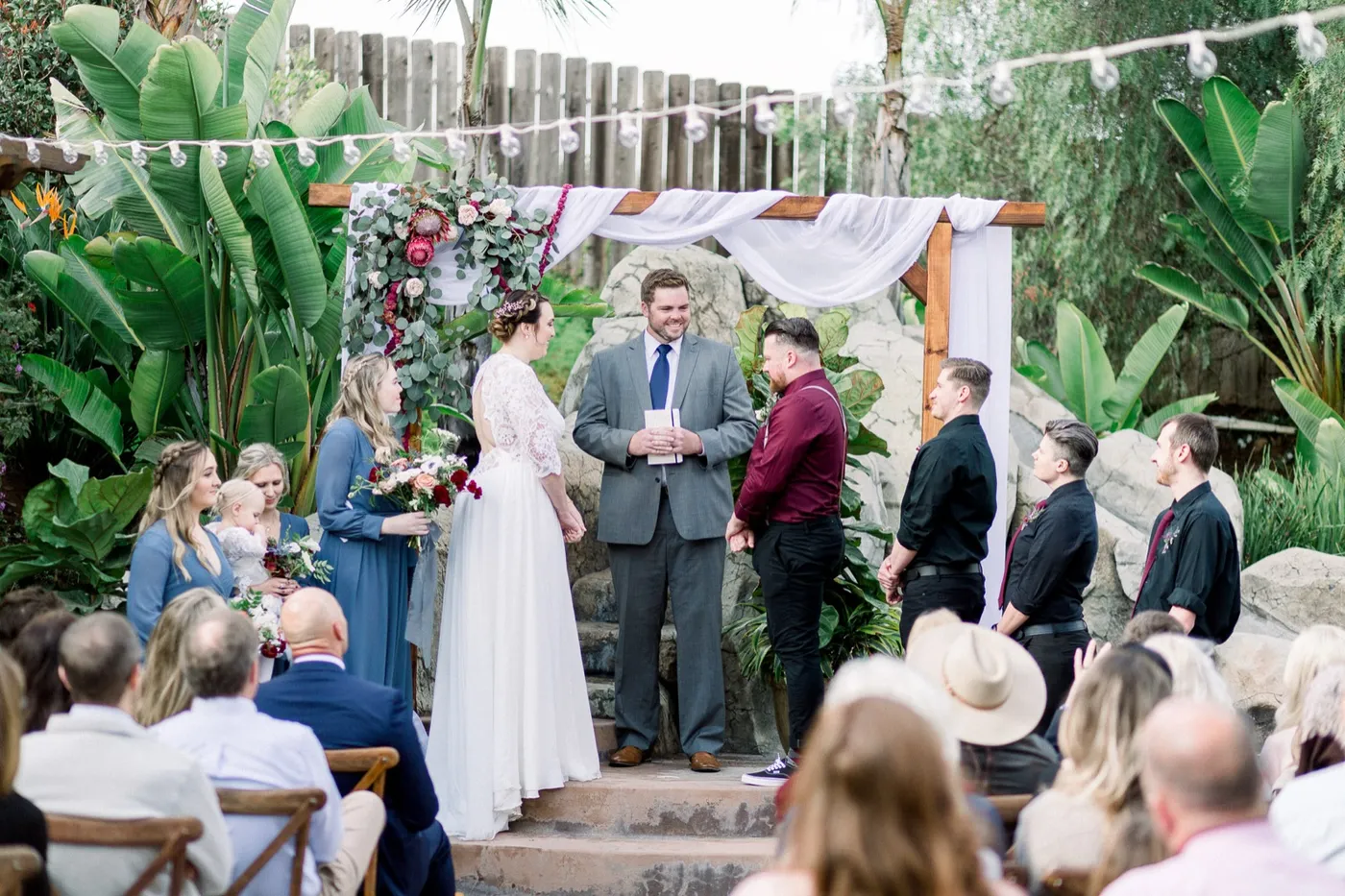
Yes, you can get married in a backyard in the Las Vegas valley. The City of Las Vegas and Clark County write their special event permits for public streets, city facilities, and commercial property, so a private wedding held at a home doesn’t need one, and there is no guest number that changes that.
What a venue would have supplied, you supply instead. You rent the tent, the tables and chairs, the restrooms, the power, the lighting, and the floor, and that pile of rentals usually costs about what a venue fee would have cost.
Then there’s the desert, which no national planning checklist covers. A yard has no roof and no air conditioning, so the month you pick and the hour you start the ceremony change how the whole day feels. I’ve photographed weddings every year since 2010, more than 300 of them, and I’ve shot at private estates and ordinary backyards all over this valley. The couples who ended up happy with how their day went picked the date and the ceremony time around the heat and the light before they planned anything else.
Is a backyard wedding allowed in Las Vegas?
For a private wedding at a home, mostly yes. There’s no permit for the wedding itself. There are four things to check before anyone puts money down: the noise rule for whichever jurisdiction the house sits in, the rules of the homeowners association if there is one, the short list of things that do need a permit, and the licenses held by the people pouring the drinks and cooking the food.
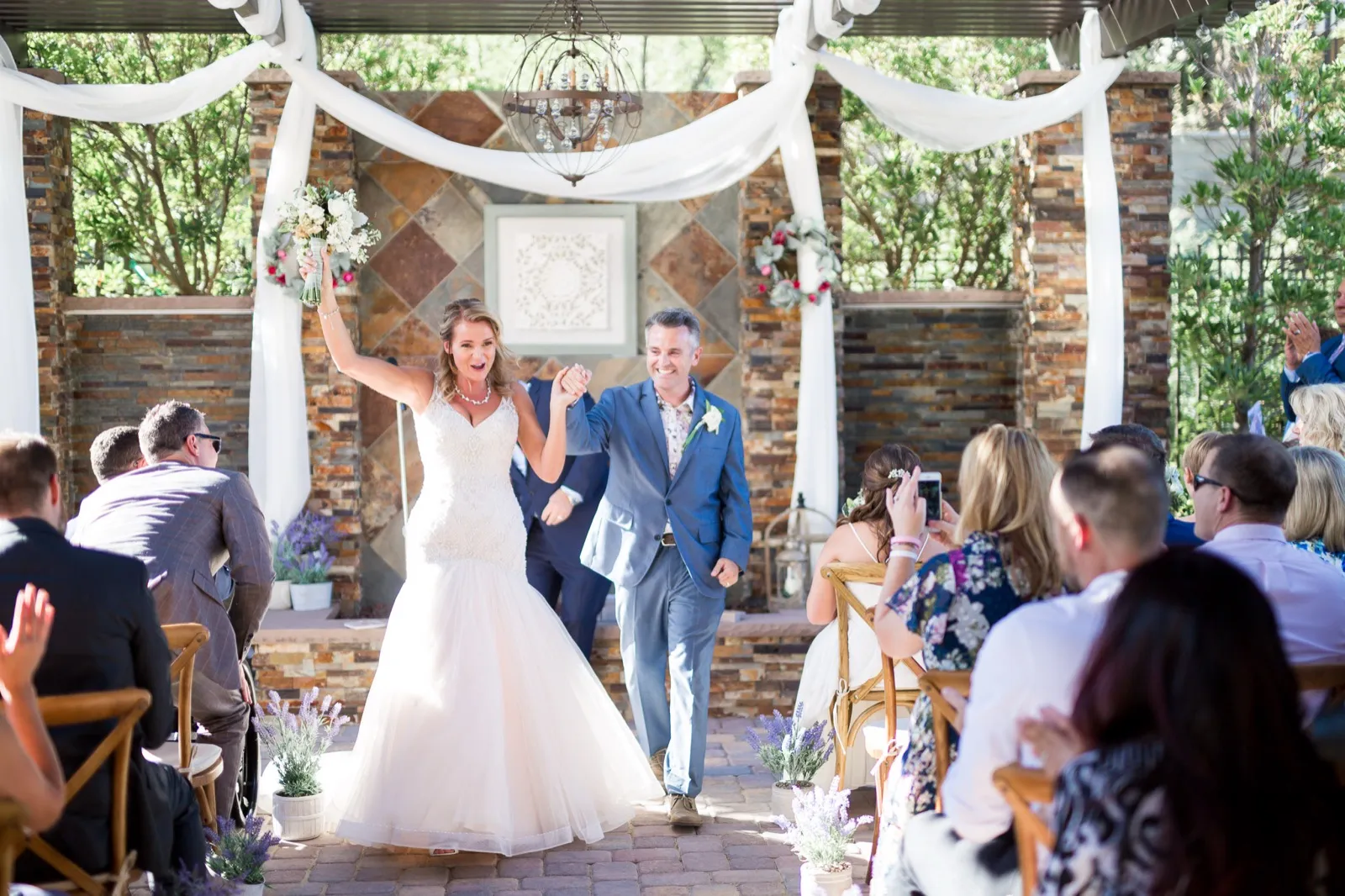
First, find out which jurisdiction the house is actually in
Do this before you look up a single rule. Plenty of valley addresses that say Las Vegas in the mailing address aren’t in the City of Las Vegas at all. They’re in unincorporated Clark County, which is a separate jurisdiction with a separate code. Henderson is its own city with its own rules again. The three don’t agree on the part you care about most, which is when the music has to stop.
The mailing address won’t tell you. Look up the property record for the parcel, or call the jurisdiction you think you’re in and ask them to confirm the address is theirs. It’s one phone call, and it decides which set of noise rules you’re planning around.
What your HOA can do about it
If the house is in a homeowners association, those rules are the ones most likely to affect your day, and they’re the ones I can’t look up for you. Nevada law gives an association real power here. Under NRS Chapter 116, an association can adopt rules and enforce them, and its board can impose fines for violating the governing documents. The CC&Rs are binding on whoever owns the house.
What those rules actually say is different in every community, and I’d be guessing if I told you what yours says. So read the CC&Rs for that specific address, and call the management company before anybody puts down a deposit. Ask about guest parking, amplified music, tents, and whether anything in the rules applies differently to a large gathering.
One thing in your favor: Nevada requires an association to enforce its rules uniformly, and a rule that is not uniformly enforced cannot be enforced against any owner. So if other homeowners in your community have held big parties in their yards without any trouble, that’s worth saying out loud when you talk to the board.
Music, noise, and when the amplified sound has to stop
This is the rule that decides how your reception ends, and all three jurisdictions handle it differently.
| City of Las Vegas | City of Henderson | Unincorporated Clark County | |
|---|---|---|---|
| The standard that applies to a private yard | Sound from a stereo, instrument, or amplifier that is plainly audible 50 feet from the source is evidence of a violation | Amplified sound that is plainly audible to another person and unreasonably disturbs their peace and quiet | Noise that is physically annoying to a person of ordinary sensitivity, or unusual in its time or place |
| A fixed cutoff time for amplified music | None written for a private yard. The code’s 11 p.m. to 7 a.m. limit on loudspeakers is written for public streets and public spaces | 10 p.m. to 7 a.m. on weekdays, and 10 p.m. to 10 a.m. on weekends and holidays | None. Time of day is one factor an officer weighs. The county also sets sound limits by zoning district |
| What that means for your reception | Set your own end time. A neighbor can complain at any hour | Amplified music ends at 10 p.m. | No fixed cutoff, so the real limit is what your neighbors will put up with |
Here’s the practical part. A DJ playing outdoors will be heard from fifty feet away, and fifty feet is about the width of two backyards. So you can’t turn the music down far enough to get under the Las Vegas standard. What works instead is talking to the neighbors. Go see them in person before the invitations go out, tell them the date and the time the music stops, and then actually stop it at that time. If you want the night to keep going after that, move the last part of it inside the house.
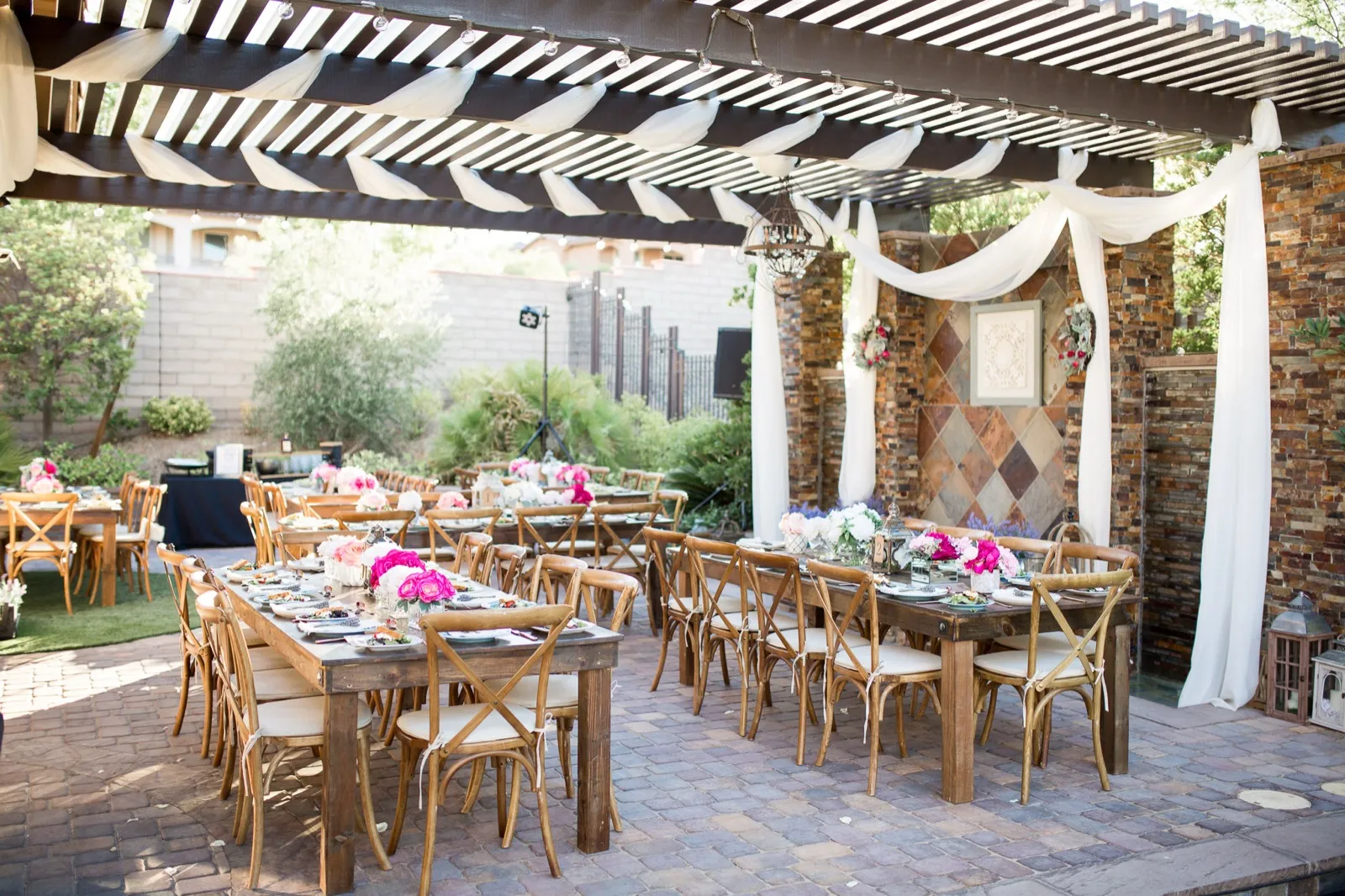
Henderson is the one jurisdiction that gives you a set time, so if the house is there, plan on the amplified music ending at 10 p.m. and build the evening backward from that. Clark County gives you no time at all, which sounds easier than it is. With nothing written down, the only limit on your reception is what a neighbor is willing to put up with.
When you actually need a permit
You need one when part of your wedding moves off the property and into public space. The City of Las Vegas special event permit covers events at city facilities, on city streets and rights of way, and on commercial property. A private home isn’t on that list. In unincorporated Clark County, special event permits are written for temporary commercial and community uses like festivals and street fairs, and Clark County Public Works requires its own permit for any outdoor event that affects the normal flow of traffic on a public street.
So what actually triggers a permit is practical, not numerical: closing or blocking a street, parking or traffic spilling into the public right of way, a tent over the size limit, and running the property as a commercial venue. That last one means charging admission or renting the yard out for other people’s events, not hosting your own wedding at your own house. Your guest count isn’t among them, and no jurisdiction here publishes a headcount at which a permit starts.
The tent is the one people miss. Under the Southern Nevada fire code, a tent or membrane structure larger than 400 square feet needs a permit from the fire code official. Four hundred square feet is a 20 by 20 tent, and a seated dinner for 100 people needs a tent several times that size. Ask your rental company about it early. Pulling that permit is normally their job, and they’ll know whether the county’s current code, adopted in December 2025, treats a tent at a single family home any differently, and whether a canopy without walls falls under a different threshold than an enclosed tent.
Do you need a permit to serve alcohol at a backyard wedding?
Not for handing your own guests a free drink at your own house. What Clark County licenses is the business of selling and serving liquor: package stores, taverns, and liquor caterers. Hosting an open bar for invited guests isn’t that business.
Money is what changes the answer. If you sell drinks, run a cash bar, or charge admission that covers the drinks, you’re into the county’s off premises liquor permits, which come in a for profit version and a non profit version. So host the bar, and don’t sell anything at it.
If you hire a bar service, the licensing is theirs, and it’s worth checking. A bar company working in unincorporated Clark County has to hold a county liquor caterer license and then pull a separate event permit for your specific date, applied for about two weeks ahead, at $10 per service station. Ask for the license number, and ask them to confirm the event permit is filed for your date. If the house is inside Las Vegas, North Las Vegas, or Henderson city limits, the city licenses this rather than the county, so ask the city.
The liability rules are narrower than most couples expect. Under Nevada law, you are not liable in a civil suit for what an adult guest does after you served them. You are liable if you knowingly serve alcohol to someone underage, or knowingly let someone underage drink on property you control, which describes a backyard exactly. So make checking IDs the bartender’s job, and say that out loud when you book them.
Does your caterer need a health permit to cook at a private home?
Yes, and the permit belongs to the caterer, not to you. The Southern Nevada Health District regulates food establishments across Clark County, and its definition of one covers a catering operation that serves food directly to people. Ask your caterer for their health district permit the same way you’d ask for a certificate of insurance. You don’t pull a permit as the homeowner.

For a friend or a relative cooking, the line is money. Private homes are exempt from food permit requirements unless the food is sold or provided for compensation of any kind. Your aunt cooking for free isn’t running a food establishment. The moment she’s being paid, she is, and the exemption stops.
Even when it’s legal, think hard about it. A home kitchen isn’t set up to hold food for 100 people at a safe temperature. The health district’s line is 41 degrees or below, or 135 or above, and anything held in between has to be served or thrown out within four hours. That clock is hard to beat with a residential fridge and a couple of ovens, and beating it is what actually goes wrong at home cooked weddings, rather than anything to do with permits.
Can you rent a house in Las Vegas for a wedding?
You can rent a short term rental house for your people to sleep in. You can’t hold the wedding at one. This question comes up a lot, usually after somebody has already found a house with a pool they love.
In unincorporated Clark County, the short term rental ordinance caps occupancy at the lesser of two people per bedroom or ten people per unit, and it prohibits parties, events, and other gatherings that go over that cap. The City of Las Vegas goes further and does not allow weddings or other special events at a licensed short term rental at all. The county’s licensing program has been blocked by a federal injunction since December 2025, but that case is about licenses and fines, and it doesn’t make event use lawful. So a rental house can hold your out of town family for the weekend. The wedding itself has to happen somewhere events are allowed.
Your own yard, or a private property that already hosts events
There are two real versions of a Las Vegas backyard wedding, and the planning for them barely overlaps. A hotel or a golf club is a third path entirely, and I’ve written about how that one works at Green Valley Ranch.
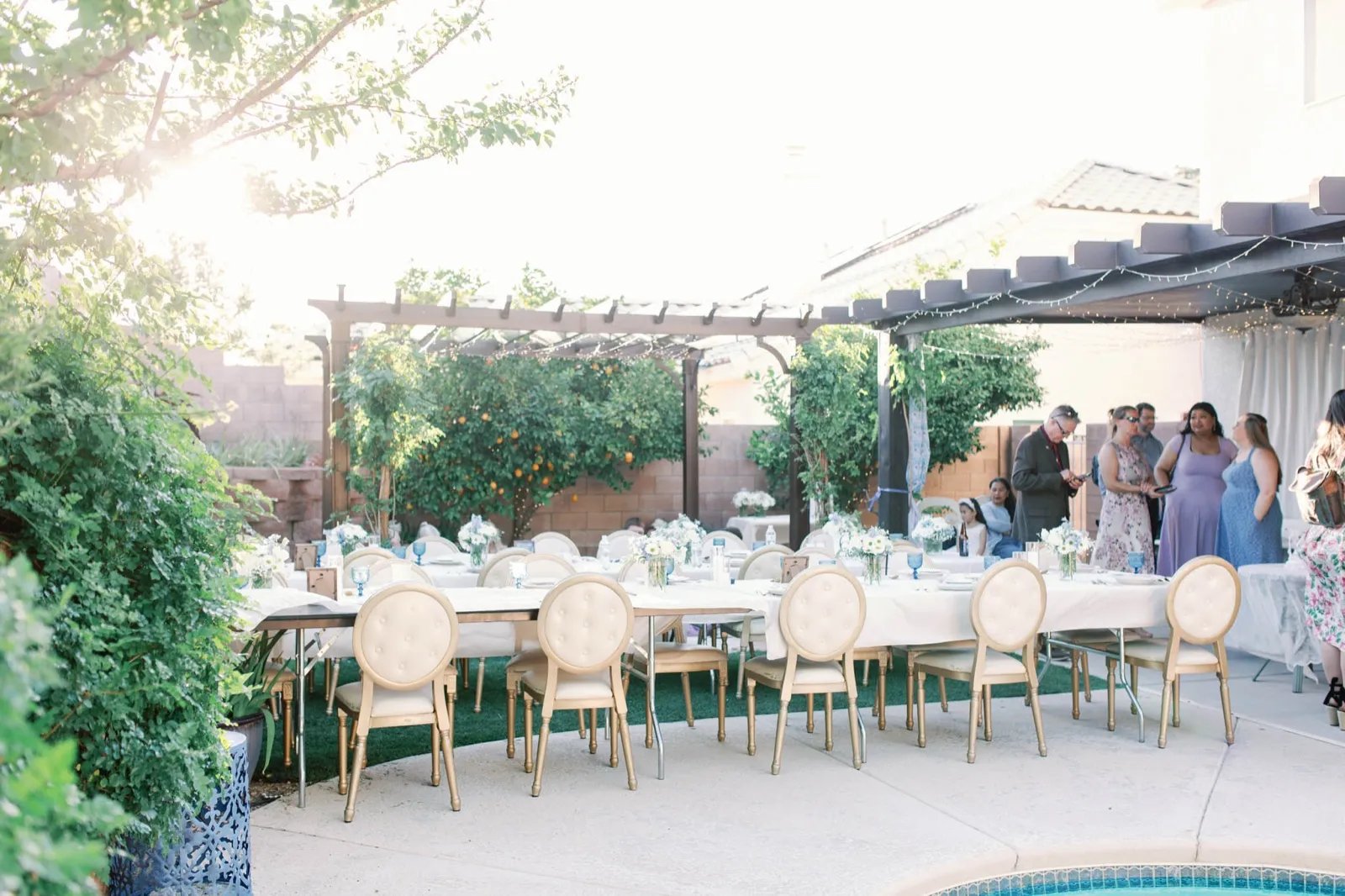
If the yard is your own, start by finding out how many people actually fit. That’s a measuring question, and you can answer it this afternoon with a tape measure. A Las Vegas rental company sizes a seated dinner with a dance floor for 100 guests at a tent of roughly 30 by 45 up to 40 by 60 feet. That footprint has to be flat, clear ground, with nothing overhead and room to walk around the outside of it. A 20 by 40 tent only works if people are standing with drinks. Go measure the widest clear rectangle in the yard before you build a guest list around it. The yard sets your guest count either way, and it’s much easier to find out now than after the invitations go out.
| A yard you or someone you know owns | A private property that already hosts events | |
|---|---|---|
| Getting permission | Ask the owner, then read the CC&Rs and call the HOA | Ask what approval the property holds to host events, and get the answer in writing |
| What you supply | All of it. Tent, tables, chairs, restrooms, power, lighting, flooring | It depends entirely on the property. Some include power, restrooms, parking, and furniture. Some include nothing |
| What it costs | No venue fee, plus roughly $5,000 to $12,000 of rented equipment | A site fee, plus whatever is not included in it |
| Noise and end time | Your jurisdiction’s noise rule, plus your HOA’s rules | The property’s own rules, on top of the jurisdiction’s |
The best way to find the second kind is to ask wedding vendors who work in this valley. A caterer or an event rental company knows which properties actually host weddings, because they’ve delivered to them. A listing page won’t tell you whether events are permitted at a property at all.
Before anyone takes a deposit, ask these four:
- Are weddings permitted at this property, and what approval or license does it hold to host them?
- What exactly is included, in writing? Power, restrooms, furniture, parking, setup, and cleanup, each answered separately.
- What time does amplified music have to stop?
- What insurance do you require, and do you need to be named as an additional insured?
What a backyard wedding actually costs in Las Vegas
You skip the venue fee, and then you spend most of that money again on the things the venue fee was paying for. The average wedding venue in the United States costs about $12,900, according to The Knot’s study of real weddings, and that is a national figure rather than a Las Vegas one. The equipment a backyard forces you to rent runs roughly $5,000 to $12,000 once you add it all up. At the low end of that range you spend less than you would have on a venue. At the high end the yard saves you nothing.
Here’s that spend broken into the things you actually order. Every row is a separate rental, so you can add the column, and the quantities assume 100 guests with a seated dinner and a dance floor. Each figure is labeled local, national, or one company’s quote.
| What you rent | Typical range for 100 guests | Where the figure comes from |
|---|---|---|
| Tent | $900 to $1,600 | National |
| Tables, chairs, linens, and place settings | $1,200 to $2,000 | National |
| Restroom trailer, two stations, one day | $900 to $1,400 | Local |
| Generator, towable, one day | $200 to $350 | National |
| Dance floor, plus the subfloor a gravel or turf yard needs | $800 to $1,500 | National |
| String lighting | $699 to $3,500 | One company’s quote |
| Event liability insurance | $75 to $550 | National |
| Delivery, setup, and breakdown, across three or four separate orders | $450 to $1,800 | Local |
| Total | About $5,200 to $12,700 |
The tent and the lighting are the two lines that move the most. A tent that size rents for $900 to $1,600 on its own, before anything goes inside it. Lighting is harder to pin down: one event rental company quotes $699 for a simple run of string lights over the dance floor up to $3,500 for a fully installed layout that covers the whole yard, and that is one company’s package price rather than a national average or a Las Vegas rate. Tables, chairs, linens, plates, and glassware are usually quoted per guest, at $12 to $20 a head, which is where the second row comes from. A dance floor is $600 to $900 by itself, and a lot of Las Vegas yards are gravel, pavers, or artificial turf, so add $200 to $600 for the subfloor that has to go underneath it.
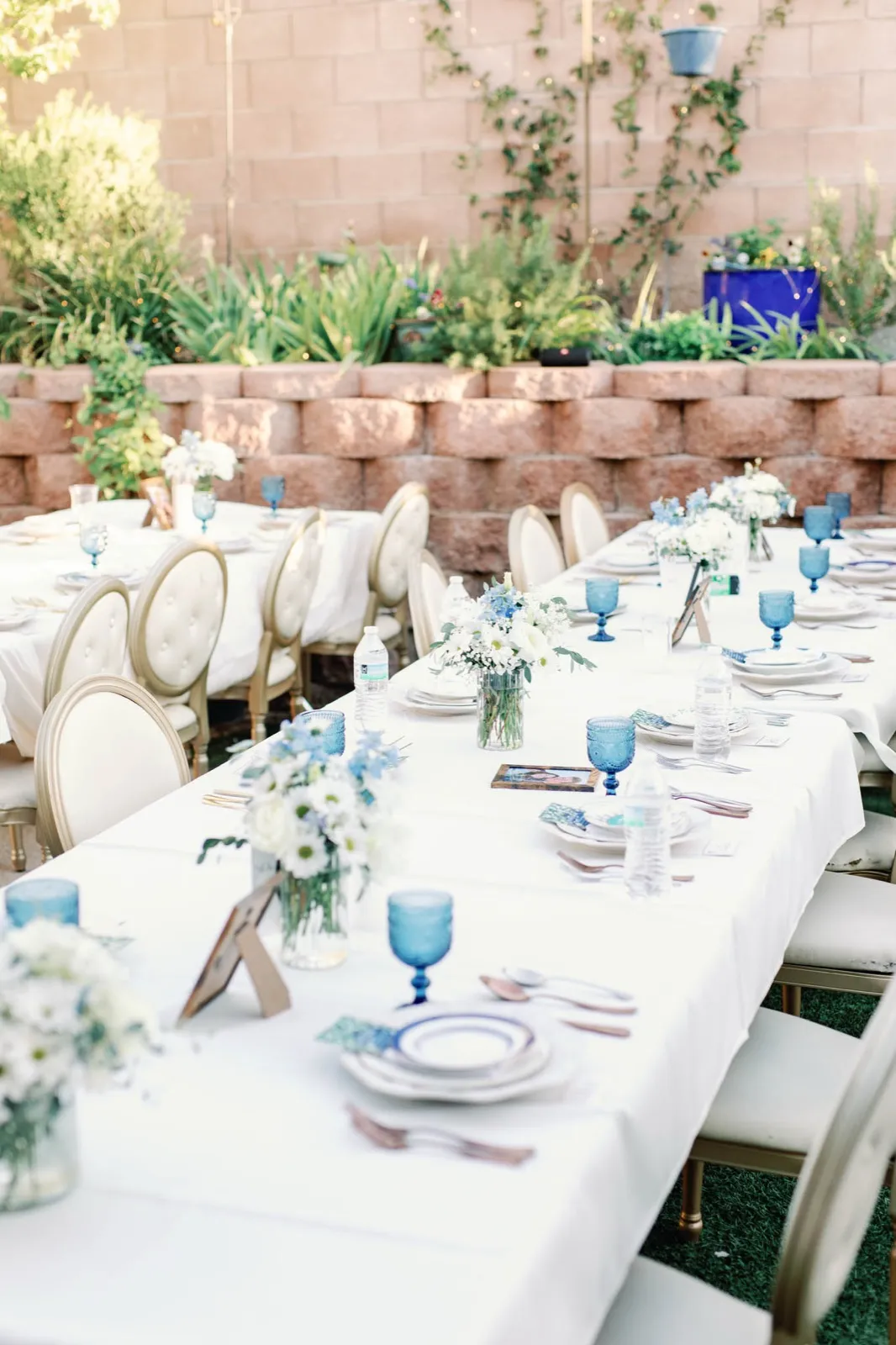
The two lines couples miss most often are the restroom trailer and the delivery fees. The trailer costs more than people picture. The house has one or two bathrooms, and you’re asking 100 people to spend six hours there. One Las Vegas restroom trailer company quotes $900 to $1,400 a day for a two station trailer, and it needs its own water and power, which is part of why a generator is on the list at all, at $200 to $350 a day for a towable unit big enough to carry catering, lighting, and a band. Trailer pricing also rises 15 to 30 percent from May through October, which is the same stretch when a Las Vegas yard is most in demand.
Delivery and setup get left out because every company you order from bills for them separately. The same Las Vegas rental company quotes $50 to $150 for delivery and $100 to $300 for setup and breakdown, per order. A backyard wedding usually means separate orders from a rental company, a restroom company, a power company, and a lighting company, so you pay those fees three or four times.
Make one phone call about insurance before you buy any of it. Some of that coverage may already be in the homeowner’s policy, so ask the homeowner’s insurance company first. Basic wedding liability coverage runs $75 to $550 depending on the carrier and the limits you buy, and caterers and rental companies commonly ask to see a $1 million limit and to be added to the certificate.
None of that pays a single vendor. Catering, flowers, music, and wedding photography all come on top of it.
Heat, light, and what time to start the ceremony
This is the part I care most about, because it’s the part I watch go wrong. A Las Vegas backyard has no roof, no air conditioning, and no way to move 100 people indoors when the afternoon gets hot. Your date and your ceremony time are the only two things you control that really change how hot your guests are.
Start with the heat. The normal daily high in Las Vegas is 99.4 degrees in June, 104.5 in July, and 102.8 in August. Those are averages, not the bad days. From June through August, a yard isn’t realistically usable in the afternoon. Misters cool a shaded zone, not an open yard in full sun. The two months where an outdoor ceremony is comfortable in the middle of the day are April, at a normal high of 78.5, and October, at 81.2. May at 88.5 and September at 94.9 both work, but only late in the day, once the sun is off the yard.
Then look at the light. A 5 p.m. ceremony in June and a 5 p.m. ceremony in October are two completely different weddings. The latest sunset of the year in Las Vegas is 8:03 p.m. on June 28. On October 1 the sun sets at 6:26 p.m. That’s about an hour and forty minutes of difference at the end of the day, so the same start time leaves you far less daylight in October than it does in June.
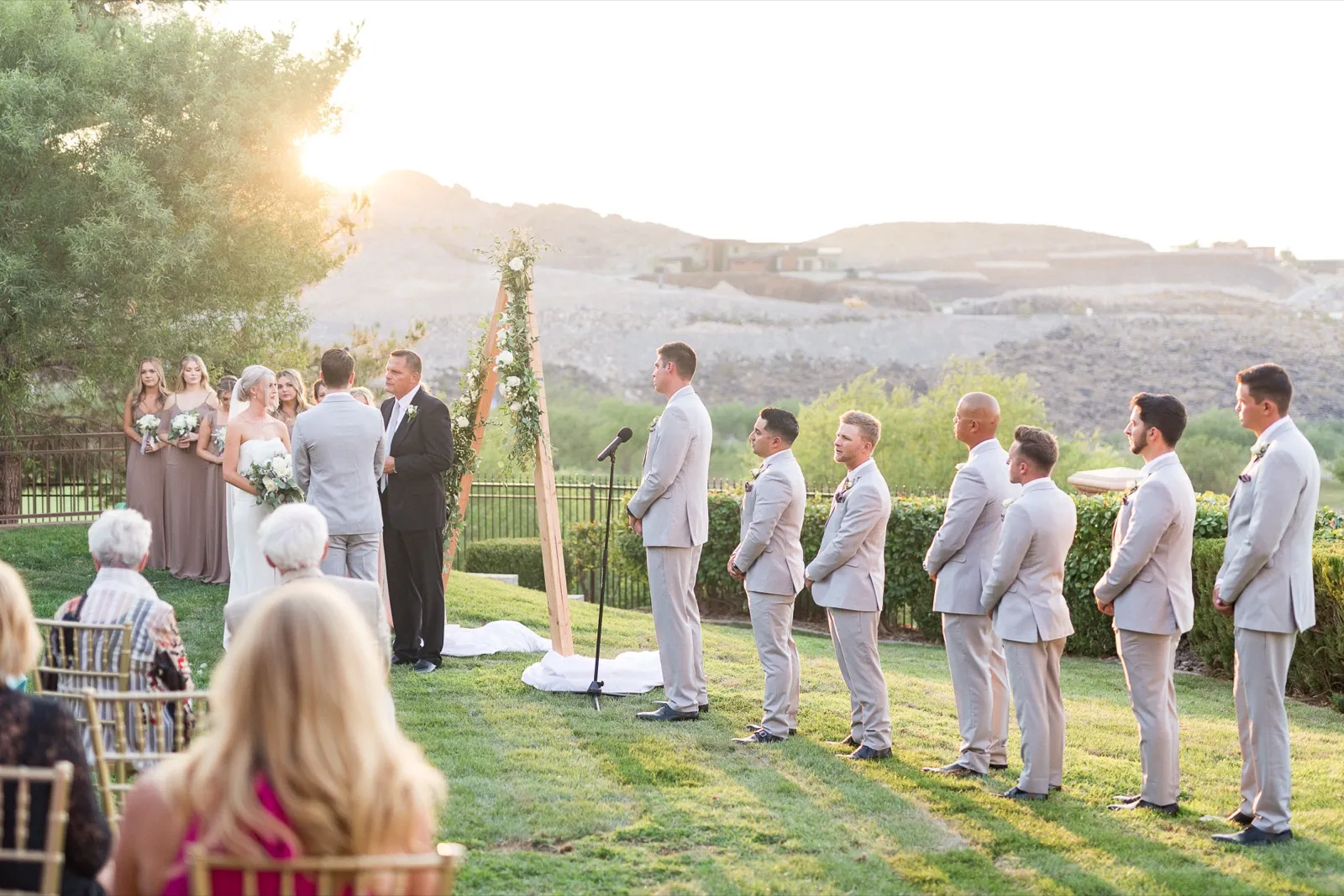
- June through August. These are the months where the plan has to change. The afternoon is unusable, and the sun doesn’t set until close to 8 p.m. in late June, so the soft light doesn’t arrive until after 7. A ceremony late enough to be out of the afternoon sun leaves you almost no daylight for anything that comes after it. If your date falls in this stretch, budget for shade and lighting before you spend money on anything else.
- September. Sunset moves from 7:10 p.m. on the first of the month to 6:27 p.m. on the last, losing about a minute and a half a day. So a wedding on September 30 has more than forty minutes less evening light than one on September 1.
- April and October. Sunset lands around 7 p.m. in early April and just before 6:30 p.m. in early October. A 5 p.m. ceremony sits inside the good light, and the reception is dark by 7, which is when your string lights become the only light you have.
Here’s my rule for a yard: go stand in it at your ceremony hour, on some day before the wedding, and look at where the sun actually is. Every yard has a wall, a roofline, or a palm that puts half the ceremony in shade and half in sun, and that split looks much worse in photos than it does to your eye. If you can, put the ceremony where the whole thing is in shade, and seat your guests so they aren’t facing into the sun.
Your guests need shade and water either way. In this climate the tent is for shade first, and rain is a distant second reason to have one. Put water at the ceremony and not only at the bar, and if your date is in May or September, plan the ceremony for the last hour before sunset instead of the middle of the afternoon. If you’re still choosing a date, I’ve also written about how to plan around a Las Vegas summer and the best time of year to get married here.
There’s one tradeoff to know about before you settle on April. The National Weather Service puts spring as the windiest stretch of the year in this valley. So April gives you the comfortable temperature and the wind risk together. October gives you nearly the same temperature without the spring wind, which makes October the safer of the two months for a backyard. April is still a good choice, and I wouldn’t talk you out of it. I’d just build the setup so it can take a gust: a weighted arbor instead of a light arch, a tent staked or ballasted by the rental company rather than by your uncle, no loose paper anywhere, and something other than open candles.
One more thing that only applies to a yard: there’s no indoor backup unless you build one. A venue has a room it can move you into when it hits 104 degrees or the wind comes up. A backyard has a house that holds maybe twenty people standing. So decide early what you’d actually do on a bad day, and if the answer is a tent, put the tent on the order before anything else.
What a Las Vegas backyard gives you on camera, and what it needs from you
Valley yards photograph better than most couples expect, and it’s because of ordinary things a lot of houses here already have.
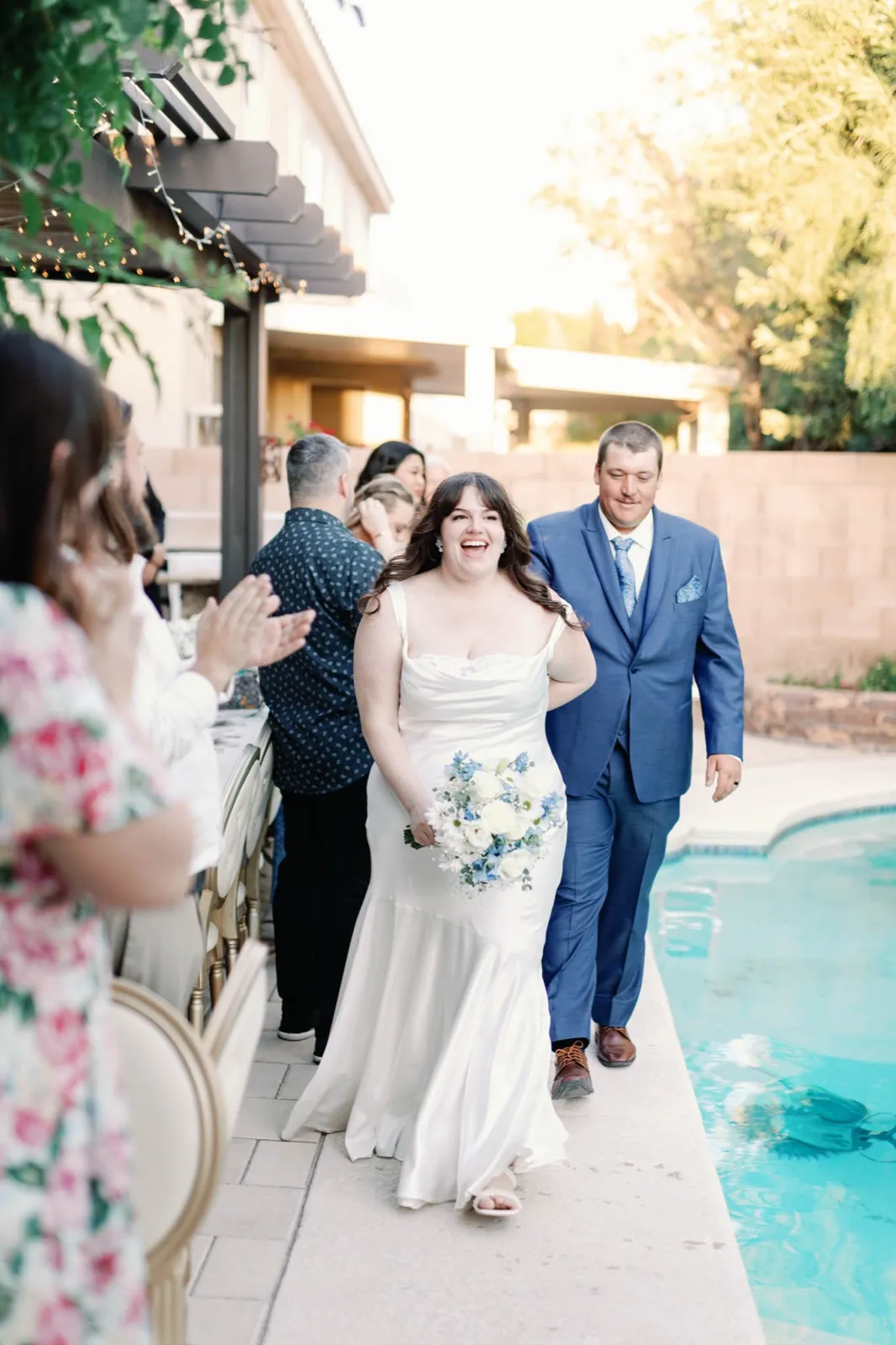
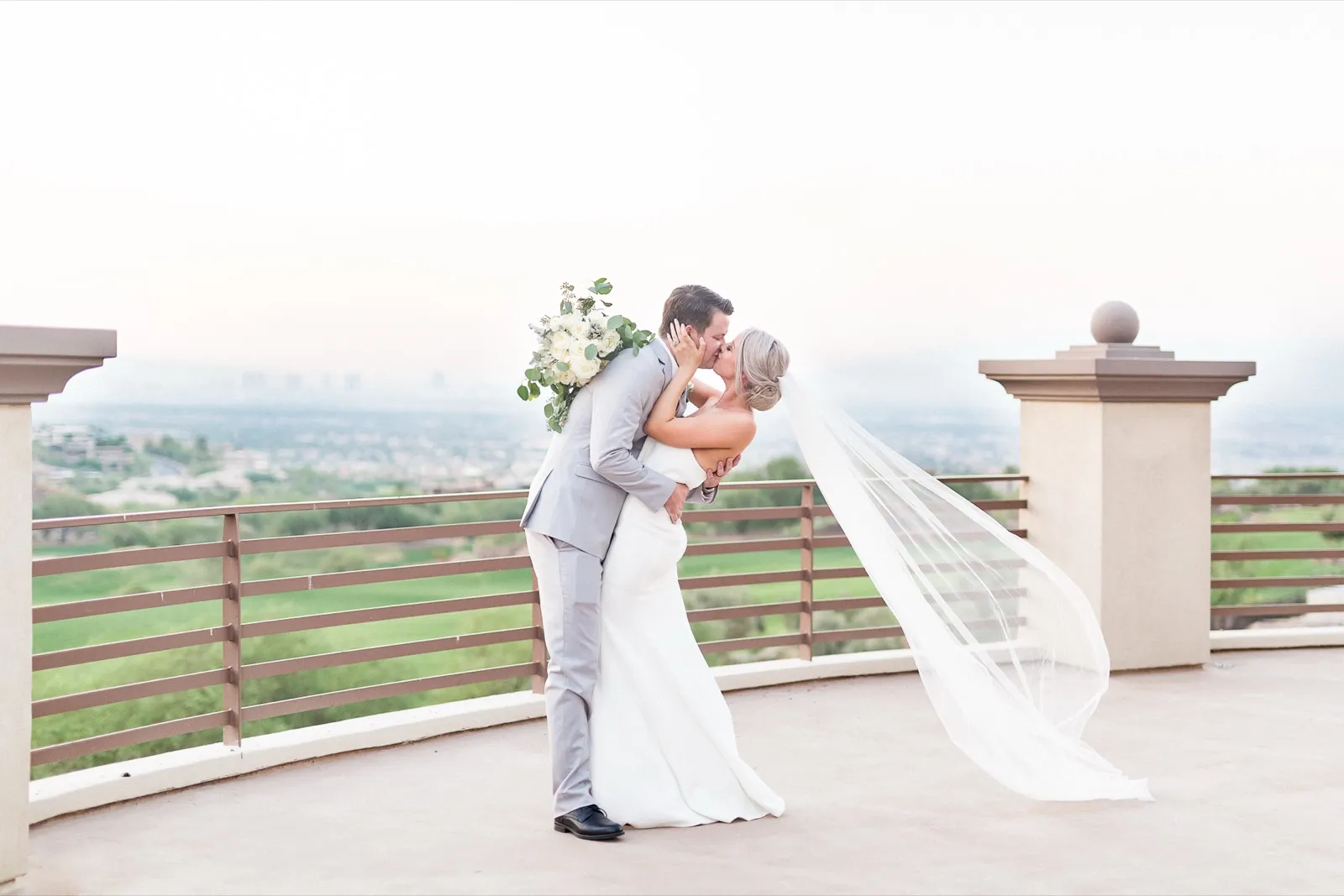
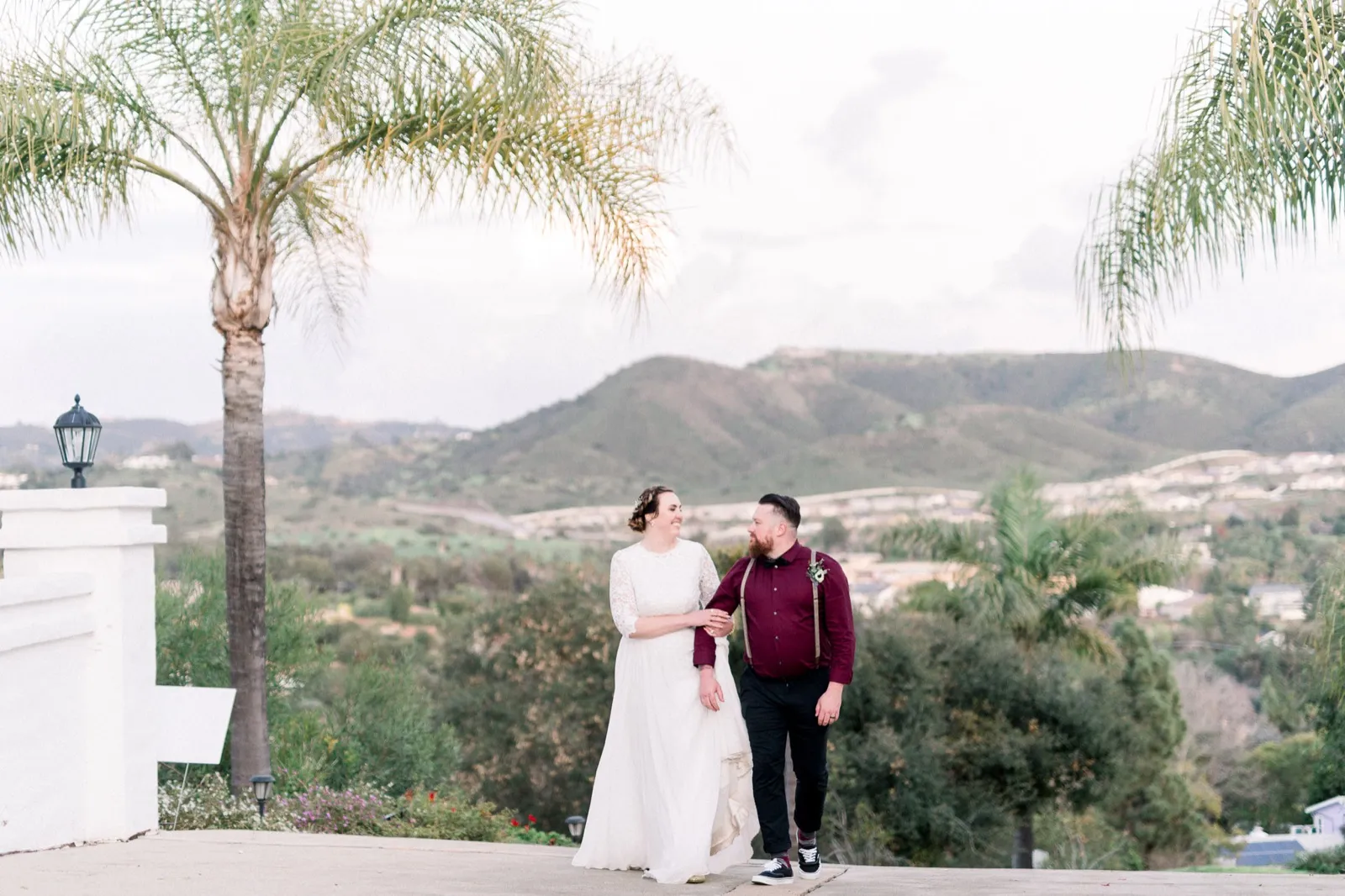
A pool is the biggest one. Water throws light back up at people during the day and holds the reflection of string lights after dark, so a pool deck is usually the best spot in the yard for photos at night. Block walls help too. Almost every yard here has one, and a plain wall gives a clean background behind you. Palms, citrus trees, and desert plantings look like Las Vegas in a photo. And on the edges of the valley, where the ground starts to climb, a terrace can put the mountains directly behind you. Some of my favorite backyard photos come from a hillside house in Henderson, for exactly that reason.
What a yard needs from you comes down to three things, and all three have to be decided before the day:
- One area that is properly lit. Pick where the first dance, the toasts, and the cake are happening, and light that spot on purpose. String lights are what make a backyard reception photograph well after dark. A dark yard with one fixture overhead gives you photos with shadows under everyone’s eyes.
- A getting ready room with a window. Pick the room with the biggest window and the least furniture, clear it out, and keep everyone else out of it. Natural light on your face in the morning is worth more than any lamp in the house. The rooms you want are the same rooms someone is carrying chairs through, so claim one early.
- Room to move. Leave a little space around the ceremony and the dance floor, and pick a spot where the two of you can step away for ten minutes near sunset. That’s where most of your portraits will happen, and it matters even more if you’re doing a first look.
The things people find out too late
- Parking. A hundred guests arrive in a lot of cars, and every one of those cars has to park somewhere. Cars spilling into the public street is one of the things that turns a private wedding into a permit question, and it’s the fastest way to annoy the neighbor you just asked for a favor. Count the spaces in the driveway, count how many cars actually fit on the street in front of the house, and if there aren’t enough, book a lot and a shuttle.
- Power draw. Add up what the caterer, the DJ, and the lighting each need, in amps, weeks ahead. A house panel was sized for a family, not for a commercial kitchen, a band, and a yard full of string lights. Your caterer can tell you their requirement in one email, and that number is what decides whether you’re renting a generator.
- Nobody is running the day. At a venue, somebody tells the DJ when to start and the caterer when to plate. In a backyard, that person is you unless you hand the job to someone else. Pick one person who isn’t in the wedding party, give them the times in writing, and tell your vendors who they are.
Do you still need a marriage license for a backyard wedding?
Yes. Wherever you hold the ceremony, you need a Nevada marriage license and someone Nevada allows to perform it. A Clark County marriage license is $102 as of 2026, and under Nevada law the person marrying you needs a certificate of permission from the county clerk unless they are a judge, a justice of the peace, or the Commissioner of Civil Marriages. If you’re wondering who has to sign, I answered that one separately in do you need a witness to get married in Nevada.
If you’re planning a wedding at a house here and you want to talk it through, email me at mckenzie@msweddingimage.com or reach out through my contact page. Tell me the address and the month, and I’ll tell you honestly what time I’d start the ceremony and where in that yard I’d put it. I’d love to hear what you’re planning.