August 29, 2026
Planning an LGBTQ+ Elopement in Las Vegas, Step by Step
Planning an LGBTQ+ elopement in Las Vegas? The order you do it in, what the county form actually asks, the witness rule, and what the whole thing costs.
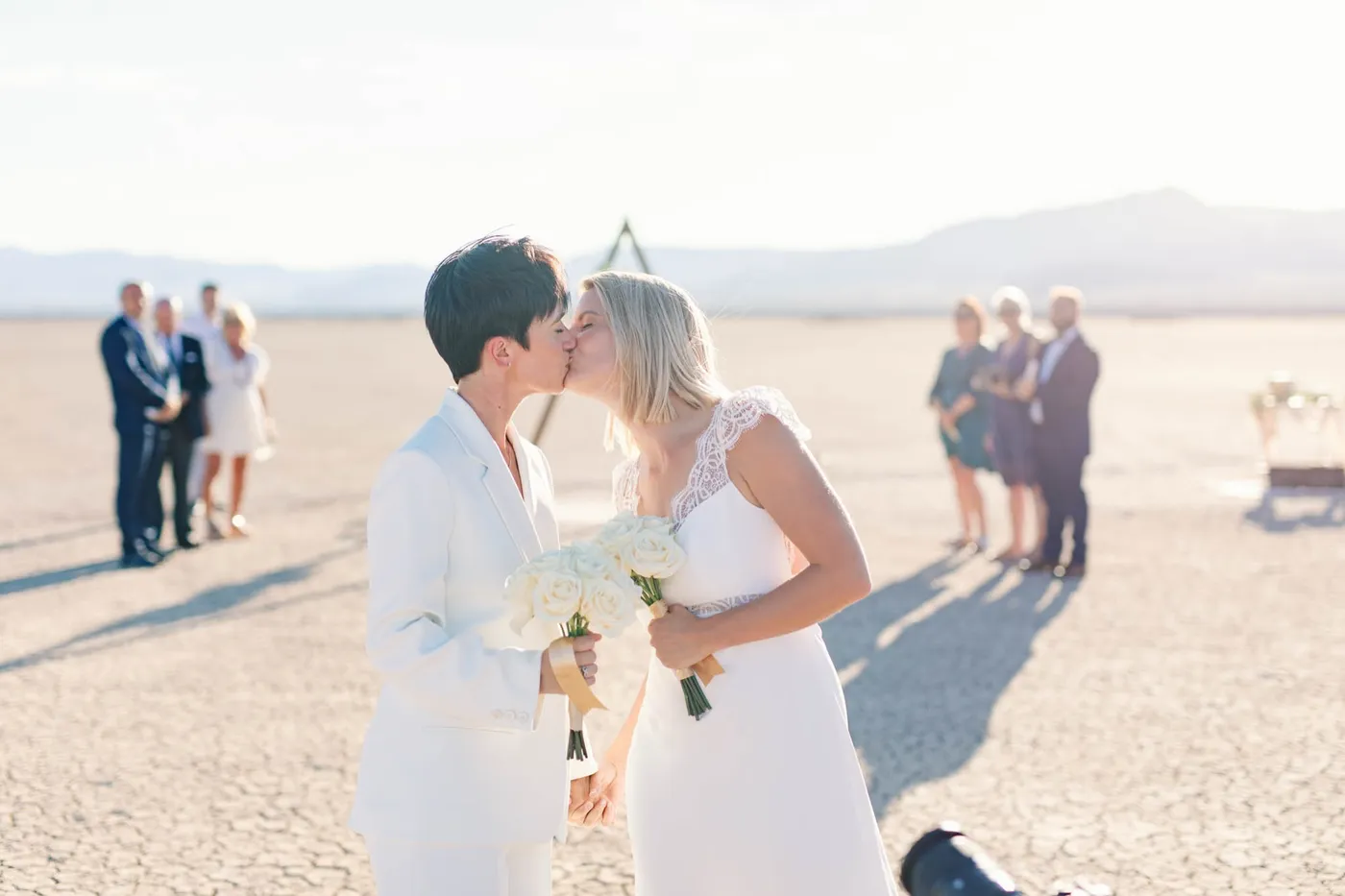
Almost everything about planning an LGBTQ+ elopement in Las Vegas works the same way it does for any other couple. You hire a licensed officiant, you go get a marriage license from Clark County, you get married with at least one witness there, and your officiant files the certificate with the county afterward. Three things are different for a same sex couple, and each one has an answer. The county’s application doesn’t sort the two of you into a bride and a groom, and both of you can give the same answer in the gender field. Most ceremony scripts are written for a husband and a wife, so it’s worth deciding early what yours will say. And you have one extra thing to do when you hire your officiant and your photographer. Ask each of them how they’ve worked with same sex couples before, so you’re not finding that out on your wedding day.
I’m McKenzie. I’ve photographed weddings in Las Vegas since 2009, more than 300 of them myself, and I photograph elopements around the valley alongside Michelle Brown, a licensed Nevada officiant.
Is Same Sex Marriage Legal in Nevada in 2026?
Yes. Same sex couples can legally marry in Nevada today, and a marriage performed here is recognized in every state in the country.
Nevada’s protection is written into the state’s own constitution, not only into federal court decisions. In 2020, voters removed the old ban and replaced it with language saying Nevada and its cities and counties have to recognize marriages and issue marriage licenses to couples regardless of gender. That made Nevada the first state to write marriage equality into its constitution.
There’s also a Nevada law about how businesses here have to treat you. Any business open to the public has to serve everyone equally, and the law names sexual orientation, sex, and gender identity or expression specifically. Wedding vendors are covered by it.
So what happens if someone does refuse? The same constitutional amendment has one exception: clergy and religious organizations can’t be forced to perform a marriage. A church or a member of the clergy can decline. A photographer, a florist, or an officiant running a business open to the public can’t turn you away on those grounds without breaking that law, and if one does, you can file a complaint about it with the Nevada Equal Rights Commission. Most couples never need to do that, and it’s still worth knowing the option is there.
Step 1: Hire Your Officiant and Your Photographer
An elopement has exactly two people to hire, an officiant and a photographer, and that’s the entire list. Start here, because dates get taken. Two people is a short list, and a few questions by email will tell you most of what you need to know about each of them.
Your officiant can’t be just anybody. Nevada requires Clark County to approve a person before they’re allowed to perform a marriage, and getting ordained online doesn’t cover it by itself. Someone who officiates for a living almost always already holds that approval, so ask them to confirm it before you book. That’s worth doing, because this is the person who makes your marriage official. They perform the ceremony, they sign the certificate, and they file it with Clark County afterward. Someone the county hasn’t approved can’t do any of that.
Asking a few questions before you book is worth the time. About 1 in 10 LGBTQ+ people who have had a wedding say they ran into discrimination somewhere in the planning, and wedding vendors were among the sources they named. That means most couples never run into it. It also happens often enough that it’s worth asking before you pay a deposit.
Photographing a same sex wedding is ordinary work for me. When people ask me who my couples are, the honest answer is that it’s usually a bride marrying a groom, or a bride marrying another bride.
What helps most is asking someone to show you something specific. Ask to see a whole wedding or elopement they photographed for a couple like you, start to finish. Ask who is actually coming to your wedding, and ask for that name in your contract. Some photographers book the job and send an associate instead, so the person you talked to and the person who shows up aren’t always the same. Ask how they’ll direct the two of you when there’s no bride and groom to work from.
“Love is love, I photograph everybody the same way” is a friendly sentence that tells you nothing about how your photos will get made. A useful answer names something the person actually does, like a same sex wedding they shot recently, or how they’d handle the moment you’re worried about. The longer list of what to ask, and what good answers sound like, is in our guide to finding an LGBTQ+ friendly wedding photographer in Las Vegas.
I’m asking you to put those questions to everyone you hire, so here are my own answers. When you book me, you get me. Every photo in my portfolio is mine, the person at your consultation is the person at your wedding, and I don’t send someone else in my place. And I don’t tell you where to put your chin or which of you stands where. I give the two of you something to do together and photograph what happens. That works the same way for any two people, so there’s nothing for me to adjust. I’ll also say plainly that I’m an ally, not a member of the community.
Step 2: Decide What the Ceremony Says
The state’s whole interest in your ceremony is that a credentialed officiant performs it and at least one witness is there. What gets said is between the two of you and whoever is marrying you.
Most standard ceremony scripts were written for a husband and a wife. They assume a certain entrance order, they assume a father handing one person to the other, and they say “the bride” and “the groom” in the places where your names belong. An officiant can drop all of it. Ask about that before you pay a deposit, not after.
Three questions are worth asking:
- Can you show me a ceremony you’ve written for a couple like us?
- Will you use the words we use for each other, whether that’s wife and wife, husband and husband, or spouses?
- What do you do about the entrance and the giving away if we want to skip both?
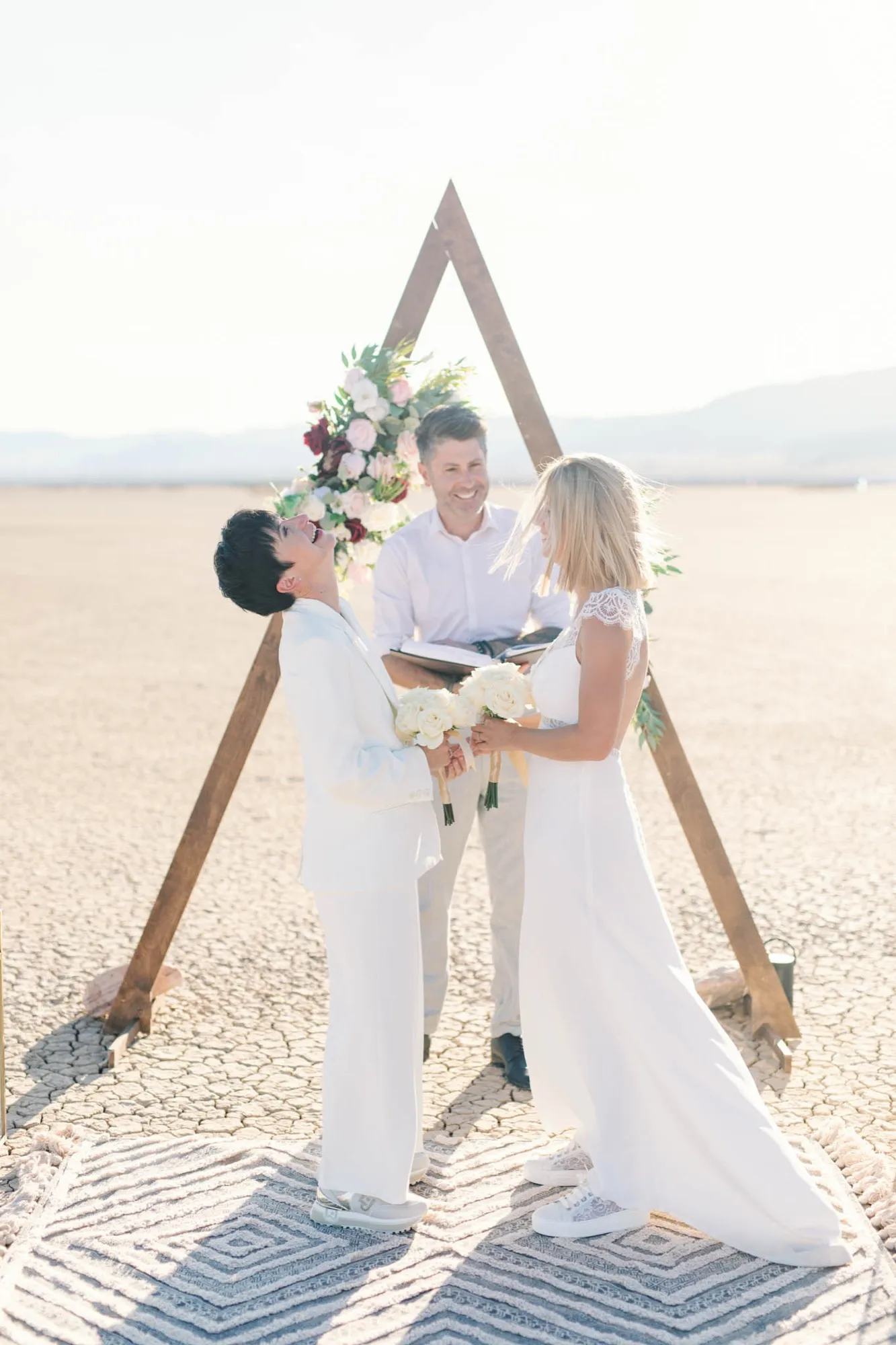
An officiant who works with same sex couples regularly will have those answers ready. Michelle Brown, the licensed Nevada officiant for our elopements, taught English at the high school and college level for years and holds a doctorate in education. She’s very good at finding words that sound like a real person said them. She keeps a set of ceremony scripts you can use as they are or change until they fit. If you’d rather write your own vows, she’ll help you shape them, or stay out of the way while you do it, whichever you want. She can write it sweet and simple, or funny, or the kind that has everyone there crying by the end.
Step 3: Pick Your Spot
You don’t have to get married in a chapel in this city. Couples elope out in the open all over the valley, and the places I shoot most are the dry lake beds, Red Rock Canyon, Valley of Fire, Mount Charleston, Lake Las Vegas, and Boulder City out by Lake Mead. Pick the one you want to see in your photos, and ask what the light is doing there at the time of day you have in mind.
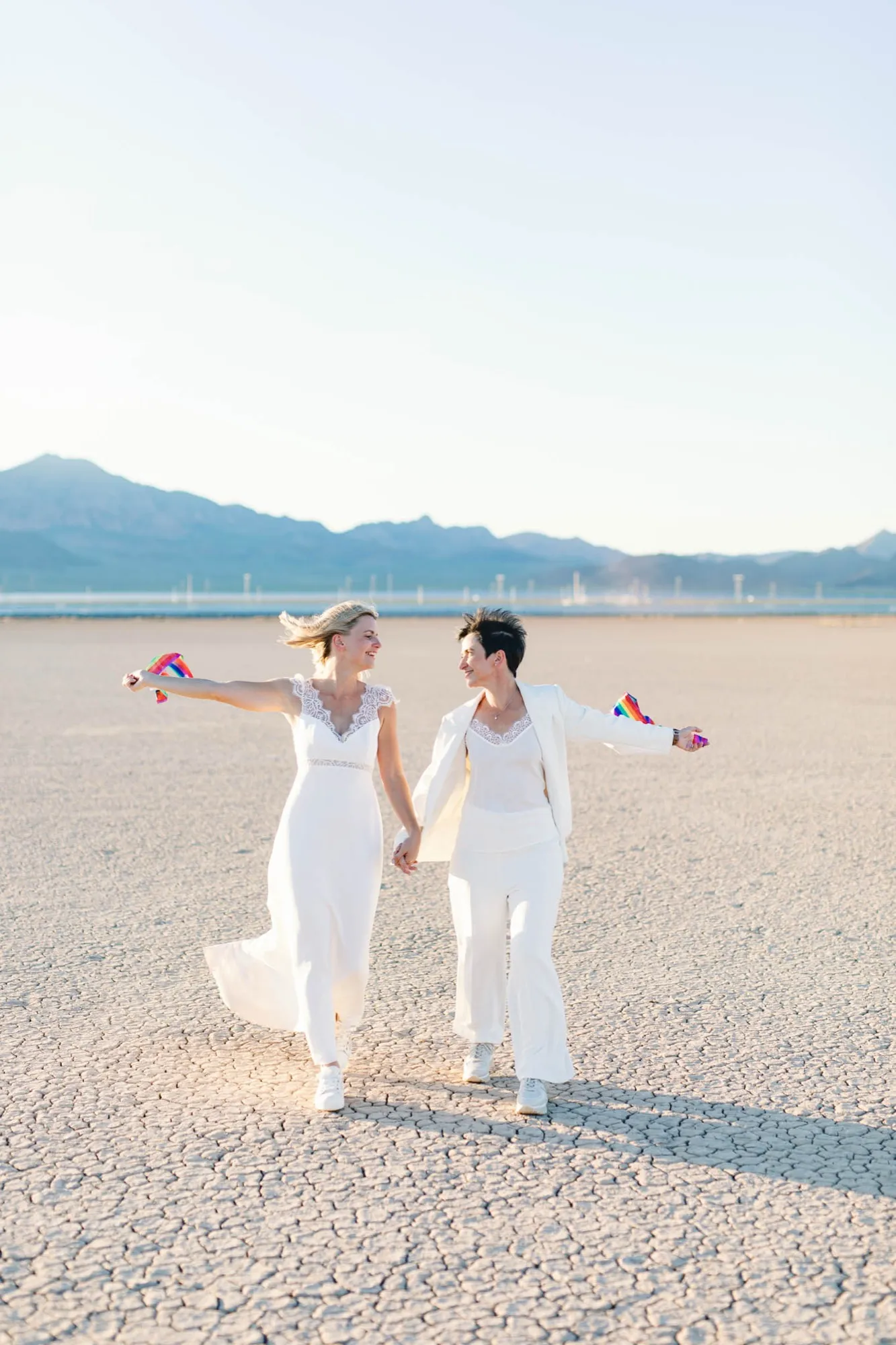
Most of those places sit on public land, so you’ll usually need a permit. Our elopement package includes the permit paperwork. If you’re putting the day together yourselves, our guide to eloping in Las Vegas without a chapel walks through these locations one at a time.
Step 4: Go Get Your Marriage License
You have to get the license before the wedding, not after. No officiant in Nevada can legally marry you until the license exists, so this has to be done and in your hands before the ceremony starts. Once it’s issued it stays valid for a year, which means you can get it months ahead or on the morning of, whichever suits your trip.
Here’s the visit itself:
- Both of you go in person to the Marriage License Bureau at 201 E. Clark Avenue in downtown Las Vegas.
- Each of you brings an original government photo ID. Not a photocopy, not a picture of it on your phone.
- The fee is $102.
- There’s no waiting period and no blood test.
- The bureau is open 8 a.m. to midnight every day of the year, it doesn’t take appointments and doesn’t need one, and the county says the stop usually takes under an hour.
If you’d rather not stand in a line, the county publishes its slowest days and hours: Sundays and Tuesdays are the least busy days, and 8 to 10 a.m. and 8 p.m. to midnight are the least busy hours. One more thing to know before you go is that the bureau issues licenses and nothing else. Your ceremony happens separately, wherever you’ve chosen, with your own officiant.
If either of you has been married before, you don’t need to bring paperwork. Clark County doesn’t need or accept proof of a divorce, and it doesn’t need a death certificate if you’re widowed. The only exception is a divorce decree that grants you the ability to use a name different from the one on your current photo ID, and that one you do need to bring. Otherwise the form just asks your marital status, which number of marriage this is, and when and where the last one ended.
What the Clark County Application Actually Asks
The application labels the two of you Party 1 and Party 2. The words bride and groom don’t appear anywhere on it. You pick which of you goes first, and that choice doesn’t affect anything else on the form. Each section is filled in for one person on their own, which means both of you can give the same answer in the gender field. Two Females on one application, or two Males, is an ordinary application here, and Nevada’s constitution requires the county to issue the license regardless of gender.
Each person’s section asks for your name, your gender, where you live now, where you were born, your date of birth, your Social Security number if you have one, whether you’ve been married before, and both of your parents’ names. There’s one shared mailing section at the end. You can fill all of it out online ahead of time, which saves you some typing at the counter. You both still have to show up in person either way.
One thing the form never asks about is your name after the wedding. That choice gets made at the counter when the license is issued. Nevada lets either or both of you take a new middle or last name at that moment, whether that’s your partner’s surname, your own birth surname, or a hyphenated combination of the two.
The form does ask each of you for a gender. It’s a dropdown with two options, Male and Female, matched to your photo ID. If your Nevada ID has an X marker, there’s no X option on the marriage application. Clark County publishes nothing about that field, nothing about a marker that doesn’t match across your documents, and nothing written for trans or nonbinary applicants. What the county does say is that your ID is there to prove your name and your age. I’m not going to guess at the rest, because the county hasn’t said. If this affects one of you, call the Clerk’s office before your visit.
The marriage certificate doesn’t use bride and groom either. That’s a different document from the license, and it doesn’t exist until after the wedding. Nevada law sets its required wording, and it describes two persons, regardless of gender, who are spouses of each other, filled in with your actual names.
Step 5: Get Married, With One Witness There
Nevada requires at least one witness at the ceremony itself, and it can’t be the person performing it. Nobody asks you for a witness at the license bureau, only at the wedding. Our elopement package includes the witness, and if you’re hiring me for photography on its own, I can be your witness, so that’s one thing you don’t have to arrange. The full rules are in our guide to whether you need a witness to get married in Nevada.
Step 6: Order the Certificate That Proves You’re Married
After the ceremony there’s one more errand, and it’s an easy one to miss. The license you signed isn’t the document that proves you’re married. The marriage certificate is, and on the wedding day you don’t have it yet.
Your officiant has 10 days to deliver the signed certificate to Clark County, and the county files it within a business day or two. After that you can order a certified copy for $20, online, by mail, or in person. Mailed orders can take up to three weeks to arrive, so order it sooner than you think you need it.
That certified copy is the document the DMV, Social Security, and your bank are going to ask for. For our elopements, Michelle files the certificate with the county. Ordering your certified copy afterward is the one piece you do yourselves.
What a Las Vegas Elopement Costs
The marriage license is $102, and that number is the same for everyone. The other two costs, the officiant and the photographer, are what decide your total.
- The officiant: an independent officiant commonly runs $200 to $1,000, depending on how much they write for you.
- The photography: elopement coverage commonly runs $1,500 to $6,000, depending on the hours you book and where you go.
Add the license to the bottom of both ranges and you’re at about $1,800. Add it to the top of both and you’re near $7,100. Nearly all of that gap is the photography, so ask photographers what they charge early on.
Our all inclusive elopement package is $2,000 for one hour. Here’s what that covers:
- The permit paperwork for your location.
- The ceremony, written and performed by Michelle.
- My photography, with every edited image delivered in an online gallery you can print from and post from.
- A witness, if you need one.
- Ceremony music through a speaker, so your song plays.
- Champagne.
- Michelle filing your marriage certificate with the county afterward.
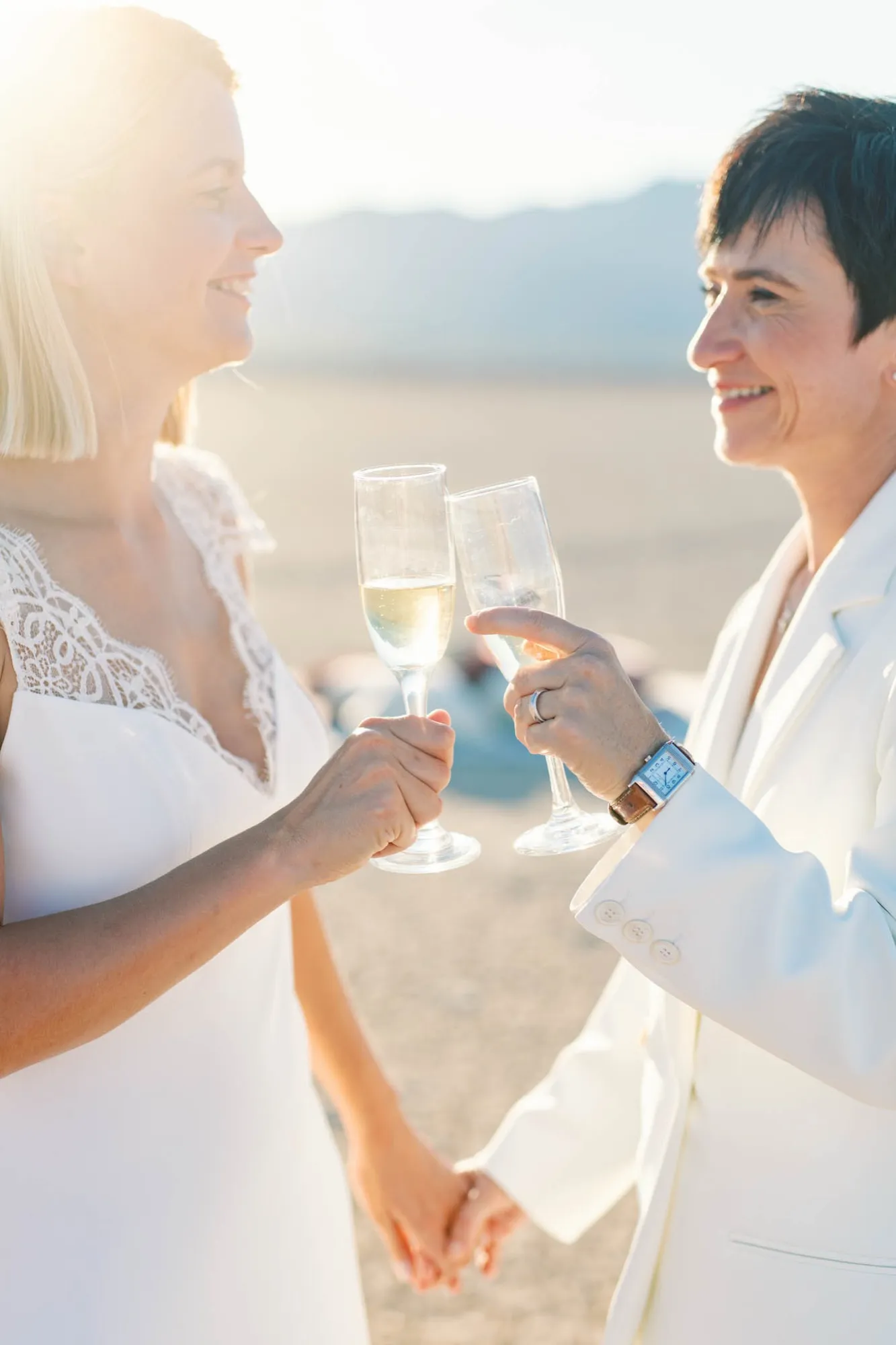
The $102 marriage license is the one cost that stays yours. Booking is open now, and the first available elopement dates begin November 10, 2026. Prices can change, so ask me for the current number when you email.
Questions Couples Ask Us
Can We Elope in Las Vegas If We Live in Another State?
Yes. The requirements are the same for visitors as for locals: both of you appear in person at the Marriage License Bureau with an original government photo ID, and a passport counts. If you need the marriage recognized in another country, the extra step afterward is an apostille from the Nevada Secretary of State once you’ve ordered your certified copy.
Will Our Marriage Be Recognized When We Get Home?
Yes. A marriage legally performed in Nevada has to be recognized in every state. That holds under the Supreme Court ruling that made marriage equality the law nationwide. The Respect for Marriage Act of 2022 adds a second protection: every state has to give legal effect to a marriage validly performed in another state.
How Far in Advance Should We Book a Las Vegas Elopement?
The marriage license needs no lead time at all, because the bureau issues it the same day you walk in and it stays valid for a year. The permit for an outdoor location is the piece that takes time, so pick your date and your spot as early as you can. Our elopement dates are open for booking now.
How Long Does the Wedding Day Itself Take?
Our elopement package is one hour, and that hour is the ceremony and the photos together. The license visit is a separate errand you run beforehand, and the county says that stop usually takes under an hour.
Do We Get Ready Together or Separately?
This one is completely your call. Nevada has no rule about it, and an elopement carries no expectation either way. Some couples get ready in the same room, and some want to see each other for the first time when they walk up to the spot. Let us know which you’re planning when we talk about the date and time, so the schedule fits it.
Let’s Talk About Your Date
If you’re planning an elopement here and you’d like the whole thing handled, email me at mckenzie@msweddingimage.com. Tell me the date you’re looking at and what you picture, and I’ll tell you what’s open and which locations look best at that time of year. Nothing has to be decided on the first email. I’d love to hear what the two of you are thinking.